Key takeaways
- A simple company website and a custom web platform should not be priced as the same product.
- The largest cost drivers are page complexity, custom UX, integrations, content migration, multilingual delivery, and post-launch support.
- An accurate proposal should describe scope, ownership, performance, SEO, testing, and maintenance—not only a page count.
How this guide was prepared
This guide is written for organisations evaluating website development cost in Egypt in Egypt. It separates this intent from direct service-page terms and avoids unsupported prices, rankings, guarantees, or client claims.
The article combines Nova Roids delivery experience, the project portfolio linked on this page, and the named primary technical references. Any volatile commercial detail should be confirmed during discovery.
What this page owns—and what it deliberately excludes
This is the canonical page for the website development cost in Egypt query family. It answers the specific decision below without duplicating the service page or adjacent cluster articles.
Topics intentionally handled elsewhere
- Direct web development company terms
- Mobile app pricing
- E-commerce platform selection
Direct service and enquiry intent belongs to our Web Development service page.
What determines website development cost in Egypt?
Website pricing starts with the business problem, not the number of screens. A brochure website, a multilingual real-estate portal, and a customer dashboard may all contain ten pages, but their architecture, data requirements, QA effort, and operational value are completely different.
Before comparing quotations, define who the site serves, which actions users must complete, what content already exists, and which systems must connect to it. This prevents a low initial estimate from becoming an expensive series of change requests.
Ready to move from planning to delivery? Review our web development process and deliverables.
- Information architecture and page templates
- Custom design versus adapted components
- CMS, database, authentication, or dashboards
- Payment, CRM, WhatsApp, maps, or third-party APIs
- Arabic and English content requirements
- Technical SEO, analytics, accessibility, and performance QA
Typical project tiers and what they include
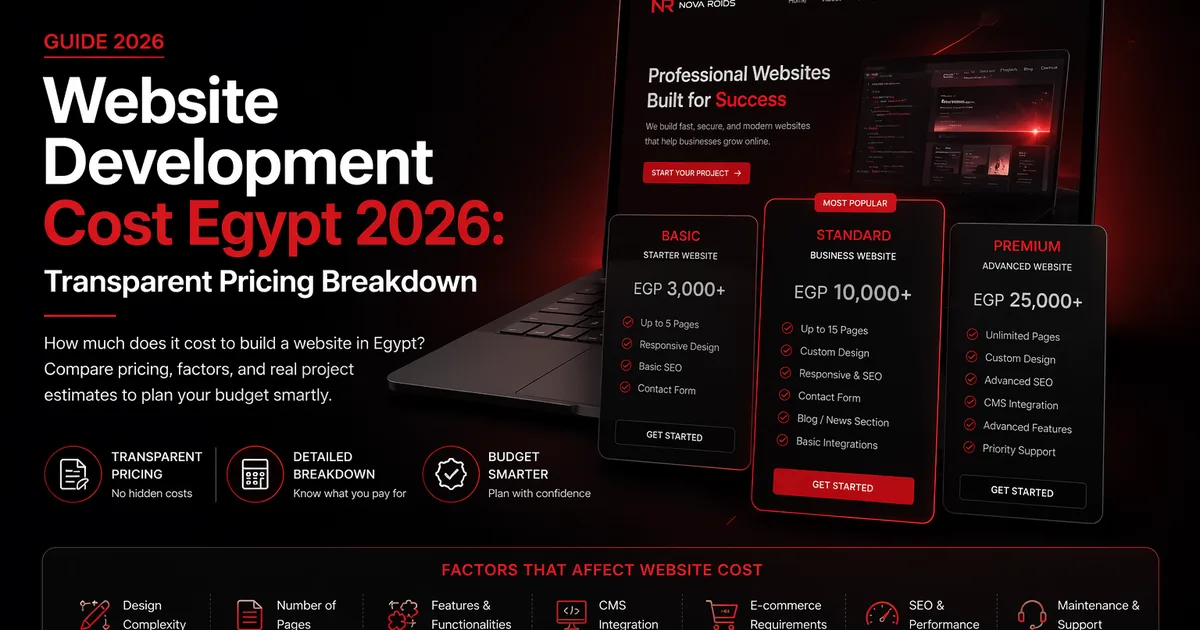
Instead of publishing a misleading fixed price, it is more useful to compare project tiers. A focused launch website usually needs a clear service structure, lead forms, responsive design, analytics, and editable content. A growth website adds reusable landing pages, topic clusters, case studies, and deeper tracking. A custom platform adds application logic, roles, databases, workflows, or integrations.
The correct tier is the smallest solution that can meet the commercial goal without forcing an immediate rebuild. Ask the supplier to identify what is included now, what is optional, and what would require a future phase.
How to compare website quotations properly
A professional proposal should state deliverables, exclusions, milestones, revision policy, content responsibilities, browser and device testing, deployment ownership, warranty, and recurring costs. Compare the same scope across suppliers; otherwise a cheaper quotation may simply exclude critical work.
The next related decision is covered in Hire a Web Developer in Egypt: Agency, Freelancer, or Team?.
- Confirm the final source-code and hosting ownership
- Request measurable performance and accessibility targets
- Check canonical, sitemap, metadata, schema, and redirect requirements
- Clarify who writes, translates, and uploads content
- Separate one-time build cost from hosting, licenses, and support
How to protect SEO during a rebuild
A redesign can lose organic visibility when old URLs are removed, canonical tags change, or internal links point through redirects. Before launch, create a URL inventory, decide which pages remain, map every changed URL directly to its closest replacement, and keep the sitemap limited to final canonical pages.
The new website should be server-rendered, fast, crawlable, and organized around one page owner per important search intent. That approach preserves existing signals while giving future content a cleaner structure.
Budget planning before requesting proposals
A useful budget begins with a written list of outcomes, users, content types, integrations, languages, and ownership requirements. Separate the must-have launch scope from improvements that can follow after real usage data exists. This makes supplier estimates easier to compare because each team is solving the same problem instead of interpreting a vague request in a different way.
Reserve decision time for content and approvals as well as development. Delays often come from missing copy, unclear legal wording, unavailable product information, or stakeholders changing priorities after design has started. A realistic website development cost in Egypt plan therefore includes internal responsibilities, feedback deadlines, and a named decision maker, not only an external development fee.
- List the business actions the website must generate
- Identify every system or API that must connect
- Confirm who supplies copy, translations, images, and legal text
- Separate launch essentials from phase-two ideas
One-time build costs versus recurring operating costs
The initial project fee is only one part of website ownership. Hosting, domain renewal, email, premium software, monitoring, maintenance, backups, security updates, content work, and future development can continue after launch. Ask for these items separately so a low build quote is not hiding expensive licenses or an unsupported production environment.
Recurring cost should match operational risk. A small brochure site may need light monitoring and scheduled updates, while a platform with accounts, payments, or business-critical integrations needs stronger support, incident handling, logging, and release discipline. The proposal should state what happens after the warranty period and how urgent problems are prioritised.
- Hosting and infrastructure
- Third-party licenses and API usage
- Maintenance and security updates
- Analytics, monitoring, and backups
- Content and SEO support
Red flags in very cheap website quotations
A quotation can look attractive because important work is missing. Common omissions include mobile QA, content migration, redirects, analytics, accessibility, performance optimisation, source-code handover, deployment documentation, and support after launch. Those gaps usually appear later as unexpected charges or as a website that technically exists but is difficult to operate and grow.
Price should be evaluated beside clarity and risk. A stronger proposal explains assumptions, exclusions, milestones, acceptance criteria, and the process for changes. It also describes how the supplier will protect existing URLs and search signals. When two estimates differ sharply, compare the underlying responsibilities before assuming the lower number represents the same product.
- No written scope or acceptance criteria
- No ownership or handover terms
- No migration and redirect plan
- No performance or browser-testing commitment
- No post-launch support model
A practical website procurement process
Start with a short discovery brief, then ask shortlisted suppliers to challenge it. A capable team should identify missing dependencies and explain which requirements create the most cost or risk. Review the proposed architecture, design process, content responsibilities, and measurement plan before negotiating the final fee. This produces a more reliable decision than comparing page counts alone.
After selecting a partner, convert the proposal into a delivery plan with accountable owners, milestone evidence, and sign-off criteria. Review working software throughout the project rather than waiting for one final reveal. Early validation catches information-architecture and content problems while they are still inexpensive to correct.
- Prepare one shared brief for every supplier
- Request assumptions and exclusions in writing
- Review a staging build at each milestone
- Test forms, analytics, metadata, and redirects before launch
When a phased website build is the better choice
A phased approach is useful when the business needs to launch quickly, validate an offer, or replace an unstable site without delaying every future feature. Phase one should still be a complete, maintainable product with correct structure, analytics, search foundations, and ownership. It should not be a disposable prototype that creates another rebuild within months.
Later phases can expand content clusters, add automation, connect a CRM, introduce customer accounts, or improve conversion based on evidence. The roadmap should explain how the first architecture supports those additions. That is where good planning lowers long-term website development cost in Egypt: the first release remains useful while growth work is added deliberately.
- Launch the smallest complete system
- Measure user behaviour and lead quality
- Prioritise improvements by evidence
- Preserve stable URLs and reusable components
A four-stage website budgeting roadmap
Begin with discovery, where the business documents users, goals, current content, integrations, languages, and constraints. Next, create an information architecture and a small set of representative page designs. Only then should the team commit to the full build, because design and technical assumptions can be reviewed before they affect every page.
The final stages are production QA and post-launch operation. Test the complete lead journey, search migration, analytics, accessibility, and performance before switching traffic. After launch, keep a prioritised improvement list based on real behaviour. This staged approach makes the budget easier to control because every phase produces evidence before the next investment is approved.
- Discovery and scope
- Architecture and representative design
- Build and staged review
- Launch, monitoring, and iteration
How to evaluate value after launch
Measure whether the new website helps the business complete its intended tasks. Relevant signals may include qualified enquiries, booking starts, calls, product discovery, application completion, support reduction, content engagement, and movement from guides to service pages. Traffic alone does not show whether the investment is working.
Review the site at fixed intervals with sales, marketing, and operations. Compare lead quality, customer questions, page performance, search queries, and technical issues. A website should become more useful as the team learns; a maintenance plan that only updates software without improving the customer journey leaves much of the investment unused.
- Qualified conversions
- Lead and customer feedback
- Search visibility by intent
- Core Web Vitals and errors
- Content and feature backlog
Website scope comparison
| Project scope | Best suited to | Main effort drivers |
|---|---|---|
| Focused launch website | A business validating one offer or lead journey | Content readiness, page templates, forms, analytics, responsive QA |
| Growth website | A company building organic acquisition and repeatable landing pages | Information architecture, reusable sections, case studies, CMS, technical SEO |
| Custom platform | A business process requiring accounts, workflows, data, or integrations | Product discovery, permissions, database design, integrations, security, testing |
Questions and checks before you commit
What clients highlighted
“The website finally explains our services clearly, loads fast, and gives our team a cleaner way to receive qualified enquiries.”
“The SEO structure made the site easier to understand. We could see which pages target traffic, which pages convert, and what to publish next.”
Relevant Nova Roids project work
These case studies show related delivery experience. They do not imply that every feature discussed in this guide was used on every project.
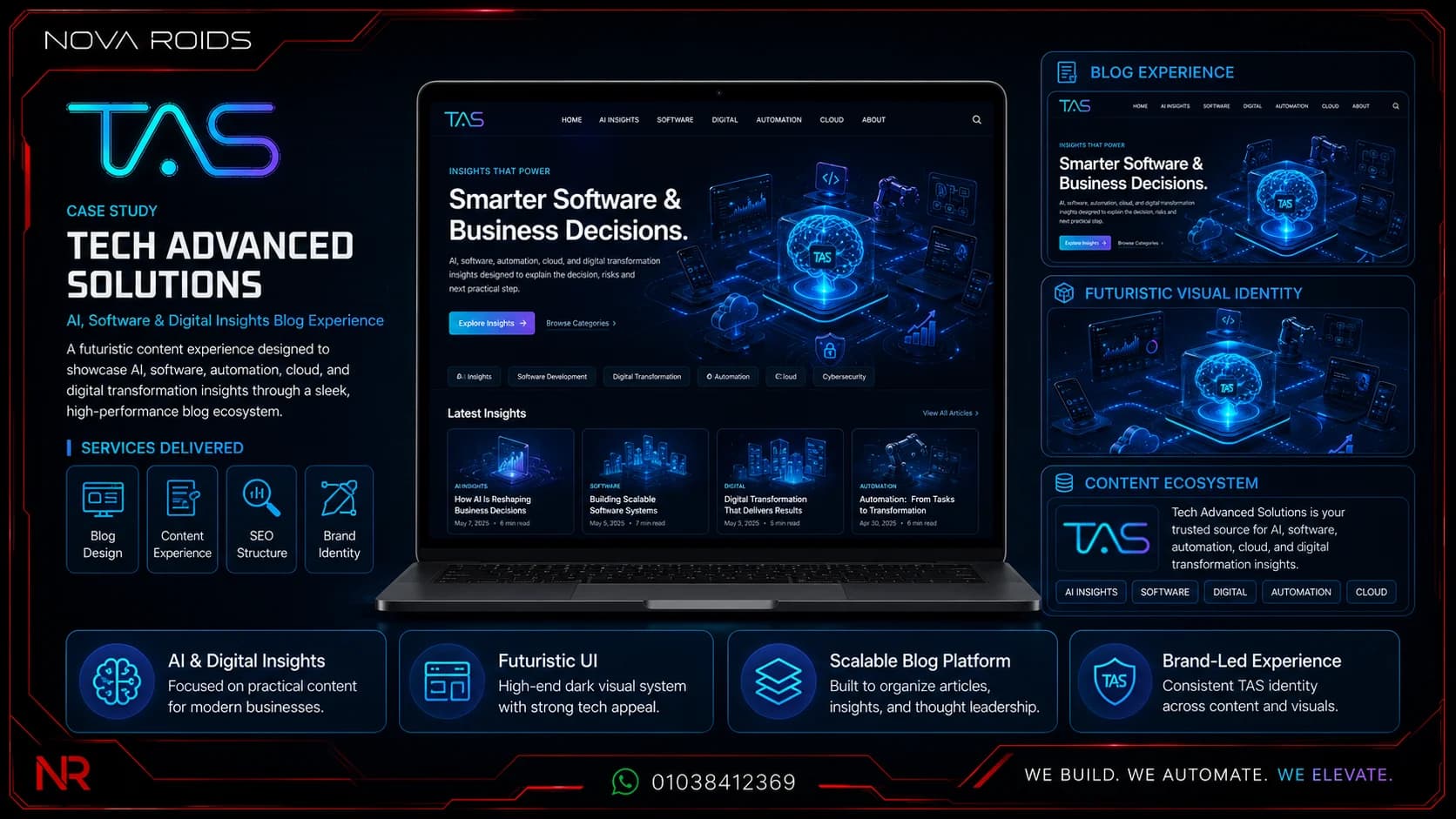
Tech Advanced Solutions
An international applied-AI, software, automation, cloud, and growth platform with product showcases and conversion-led service journeys.

Tactics Digital Agency
A high-energy agency website supported by service architecture, case studies, content clusters, and organic search acquisition.
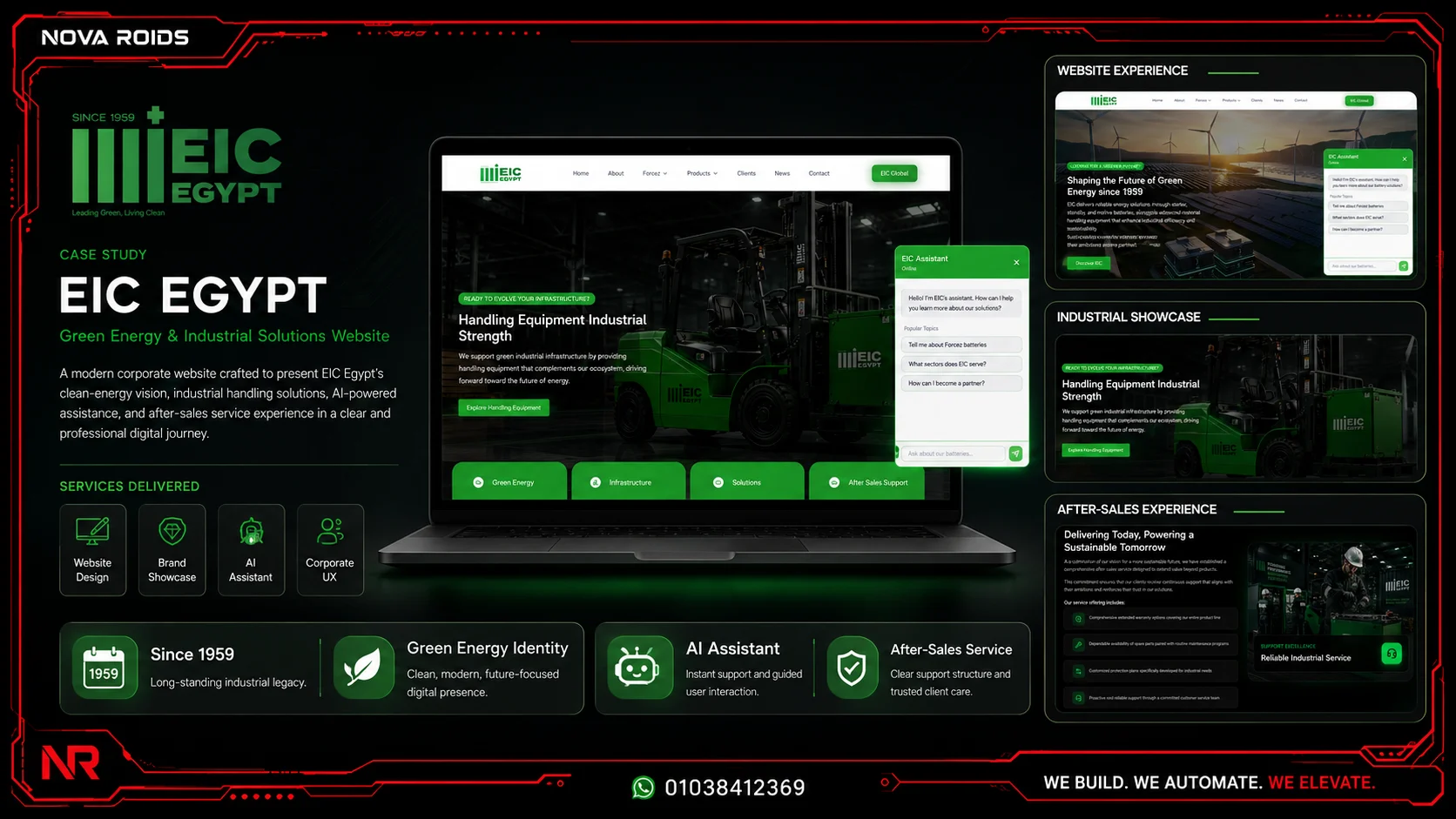
EIC Industrial Battery Platform
A bilingual industrial website presenting battery solutions, applications, company capabilities, technical content, and inquiry paths.
Frequently asked questions
How much does website development cost in Egypt?+
The cost depends on scope, custom design, content, integrations, languages, and support. A reliable supplier should price a documented set of deliverables rather than offer one universal amount for every website.
Is WordPress always cheaper than custom development?+
Not always. WordPress can reduce build time for editorial websites, but complex plugins, custom workflows, security hardening, and ongoing maintenance may narrow the difference. Choose the architecture that fits the product and operating team.
What should be included in a website quotation?+
The quotation should define pages and templates, design, development, content responsibilities, integrations, SEO, analytics, testing, deployment, warranty, recurring licenses, hosting, and source-code ownership.
Will a website redesign affect Google rankings?+
It can. Rankings are at risk when URLs, content, canonicals, internal links, or rendering change without a migration plan. A one-to-one redirect map and pre-launch technical SEO review reduce that risk.
Can I get an exact website development cost in Egypt estimate without a detailed brief?+
A precise estimate normally requires the intended users, core journeys, content, integrations, languages, ownership requirements, and launch constraints. Without that information, any figure should be treated as an early planning range rather than a committed quotation.
What should a professional website development cost in egypt estimate include?+
It should define deliverables, exclusions, assumptions, milestones, content responsibilities, testing, deployment, warranty, recurring costs, source-code ownership, and the process for approving changes. This makes competing proposals easier to compare and reduces scope disputes.
Author and technical review
Primary references
Need a scoped recommendation instead of a generic answer?
Share the current system, target users, required outcomes, and deadline. The Nova Roids team will identify the smallest practical next step and the assumptions that need validation.