
Key takeaways
- Organize content around customer decisions and commercial pages.
- Assign one canonical page to each important search intent.
- Plan distribution and conversion before publishing.
How this guide was prepared
This guide is written for organisations evaluating content marketing strategy Egypt in Egypt. It separates this intent from direct service-page terms and avoids unsupported prices, rankings, guarantees, or client claims.
The article combines Nova Roids delivery experience, the project portfolio linked on this page, and the named primary technical references. Any volatile commercial detail should be confirmed during discovery.
What this page owns—and what it deliberately excludes
This is the canonical page for the content marketing strategy Egypt query family. It answers the specific decision below without duplicating the service page or adjacent cluster articles.
Topics intentionally handled elsewhere
- Direct social media agency selection
- Paid media pricing
- Generic web development intent
Direct service and enquiry intent belongs to our SEO & Content Systems service page.
Start with the decisions customers make
Map the questions that appear before, during, and after a purchase. Separate informational questions from commercial comparison, pricing, location, and service intent. This prevents the blog from competing with the pages designed to generate leads.
Ready to move from planning to delivery? Review our seo & content systems process and deliverables.
Use query ownership to prevent cannibalization
Each important query family should have one primary page. Service pages own direct commercial terms; pricing guides own cost questions; comparison pages own alternatives; case studies prove delivery. Supporting articles link toward the owner page instead of repeating the same title and promise.
- Primary query and search intent
- Canonical owner URL
- Supporting long-tail questions
- Required internal links
- Conversion destination
- Update and consolidation policy
Build topic clusters that are useful
A topic cluster should represent a real decision journey, not a collection of near-duplicate keywords. The pillar gives broad orientation, focused articles solve specific problems, and all pages connect to the relevant commercial service.
The next related decision is covered in Choosing a Social Media Marketing Agency in Egypt.
Measure content by contribution
Track indexation, impressions, qualified clicks, assisted conversions, lead quality, and the pages users visit before contacting you. Update articles when facts or search intent change; do not change dates without meaningful improvements.
Build a query and audience map
Start with the decisions customers make from early research to final selection. Group real search queries by intent, audience, location, product, problem, comparison, price, and next step. Assign one canonical page to each primary intent. This creates a publishing roadmap and prevents several articles from competing for the same phrase.
Search Console data should influence priorities because it shows how the current site is already being interpreted. Pages with impressions and weak clicks may need better intent alignment, titles, or content. Queries appearing across several URLs may indicate cannibalisation, but confirm the page-level data before merging or redirecting anything.
- Brand and navigational queries
- Commercial service queries
- Pricing and comparison queries
- Industry and location queries
- Support and how-to questions
Design pillar and cluster relationships
A pillar owns a broad topic and provides the decision framework. Cluster pages answer narrower questions in depth. Every cluster should link back to the pillar, to selected siblings, and to the relevant commercial page. The pillar should expose every active cluster so none depend only on the blog archive for discovery.
Do not create clusters simply to reach a target number of posts. Each page needs a distinct search intent and enough information gain to deserve its own URL. When two drafts answer the same question, consolidate them and use sections or internal links rather than publishing near-duplicates.
- One broad pillar
- Focused supporting clusters
- Commercial owner
- Case-study evidence
- Bidirectional internal links
Editorial E-E-A-T and claim control
Show who prepared and reviewed the content, why they are qualified to discuss the subject, when the page was updated, and which sources support important claims. Use project case studies as experience evidence without implying that every feature or result applies to every client. Testimonials should be genuine or clearly anonymised and should not be converted into rating schema without verifiable attribution.
Create a fact ledger for changing or high-risk claims. Prices, laws, platform requirements, product specifications, and market figures should be checked against primary sources and dated. When reliable data is unavailable, use qualified language and explain what the reader should confirm.
- Named author and reviewer
- Primary references
- Transparent limitations
- Verified case studies
- Date and update policy
Content operations and refresh process
Publishing is only the beginning. Monitor indexing, impressions, clicks, query ownership, engagement, conversions, and assisted outcomes. Review whether internal links still point to the best owner and whether a new page has started competing with an existing one. Update meaningful content and the modified date together; avoid changing dates without substantive review.
Maintain a content inventory with URL, intent, owner, status, last review, inbound links, and next action. Pages may be improved, merged, redirected, or retired. A content marketing strategy Egypt programme becomes scalable when these decisions are documented rather than held in one person's memory.
- Quarterly query ownership review
- Broken-link and redirect audit
- Content refresh queue
- Conversion and lead-quality review
- Merge or retire weak duplicates
Measure contribution across the journey
Not every useful article produces an immediate enquiry. Measure direct conversions, assisted conversions, movement to service pages, return visits, newsletter or remarketing audiences, and sales-team usage. A pricing guide may qualify prospects, while an implementation guide may reduce objections or support an existing client.
Agree on a small set of metrics for each page type. Commercial pages should emphasise qualified actions. Pillars should support discovery and movement through the cluster. Cluster pages should answer a specific question and create a logical next step. This prevents all content from being judged by one metric.
- Qualified conversions
- Service-page transitions
- Cluster navigation
- Organic query growth
- Sales and customer-support usefulness
A twelve-week content operating cycle
Weeks one to three should audit existing URLs, queries, conversions, links, and technical issues. The next stage defines ownership, pillars, clusters, commercial pages, and evidence requirements. Production then focuses on a small number of high-priority pages, including reverse links from services and relevant projects.
The final stage measures indexing, query movement, clicks, engagement, and conversions, then refreshes the roadmap. This cycle can repeat quarterly. It prevents the team from publishing continuously while technical problems, cannibalisation, or weak commercial paths remain unresolved.
- Inventory and query audit
- Ownership and cluster design
- Priority production and internal links
- Measurement and refresh
Governance for multiple writers and teams
Use one brief format covering intent, owner URL, audience, evidence, exclusions, internal links, sources, author, reviewer, and update date. Editors should check that a draft adds information rather than restating another page. Developers should provide reusable components for tables, FAQs, authors, projects, and schema.
Maintain approval rules for sensitive claims and a single registry of published URLs. When a page changes role, update the registry, internal links, sitemap, and redirects together. Governance is what allows content volume to grow without recreating cannibalisation.
- Shared content brief
- Editorial and claim review
- Canonical URL registry
- Coordinated technical updates
Content by decision stage
| Decision stage | Useful content | Primary next step |
|---|---|---|
| Problem awareness | Definitions, diagnostics, mistakes, and practical guides | Move to a focused solution guide |
| Option comparison | Comparisons, costs, checklists, and case studies | Review the relevant service or product |
| Provider selection | Process, proof, team, FAQs, and scope guidance | Contact the team with a useful brief |
| Post-purchase | Onboarding, support, usage, and optimisation guidance | Improve retention and outcomes |
Questions and checks before you commit
What clients highlighted
“The landing page gave the campaign a stronger path from click to enquiry. The message, CTA, and tracking were much clearer.”
“The SEO structure made the site easier to understand. We could see which pages target traffic, which pages convert, and what to publish next.”
Relevant Nova Roids project work
These case studies show related delivery experience. They do not imply that every feature discussed in this guide was used on every project.
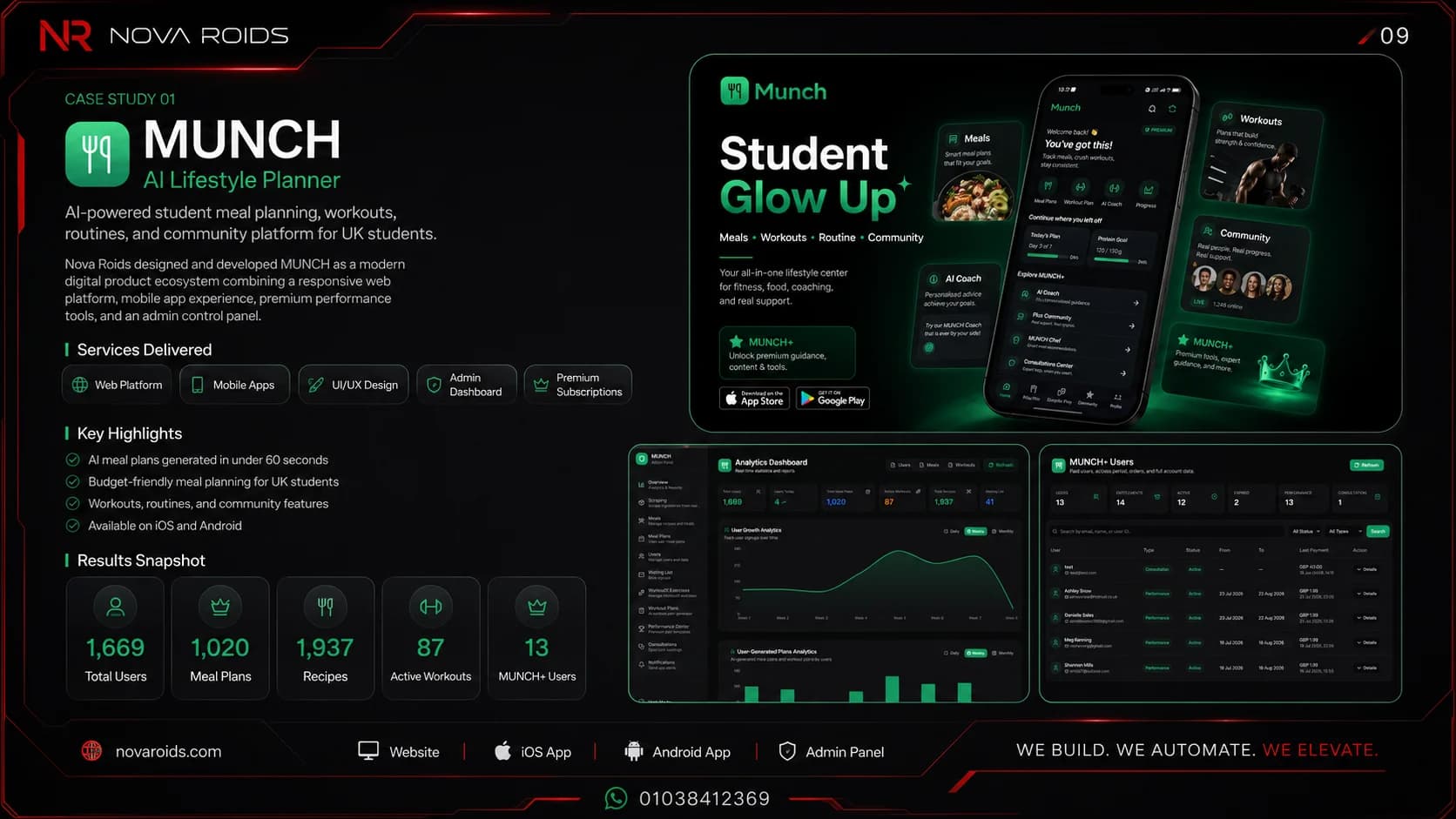
MUNCH AI Lifestyle Platform
An AI-powered mobile and web ecosystem for meal planning, workouts, performance tracking, community, and student lifestyle management.

Perla Derma Dental Platform
A bilingual dermatology and dental website combining clinical trust, service discovery, booking paths, content, and local SEO structure.
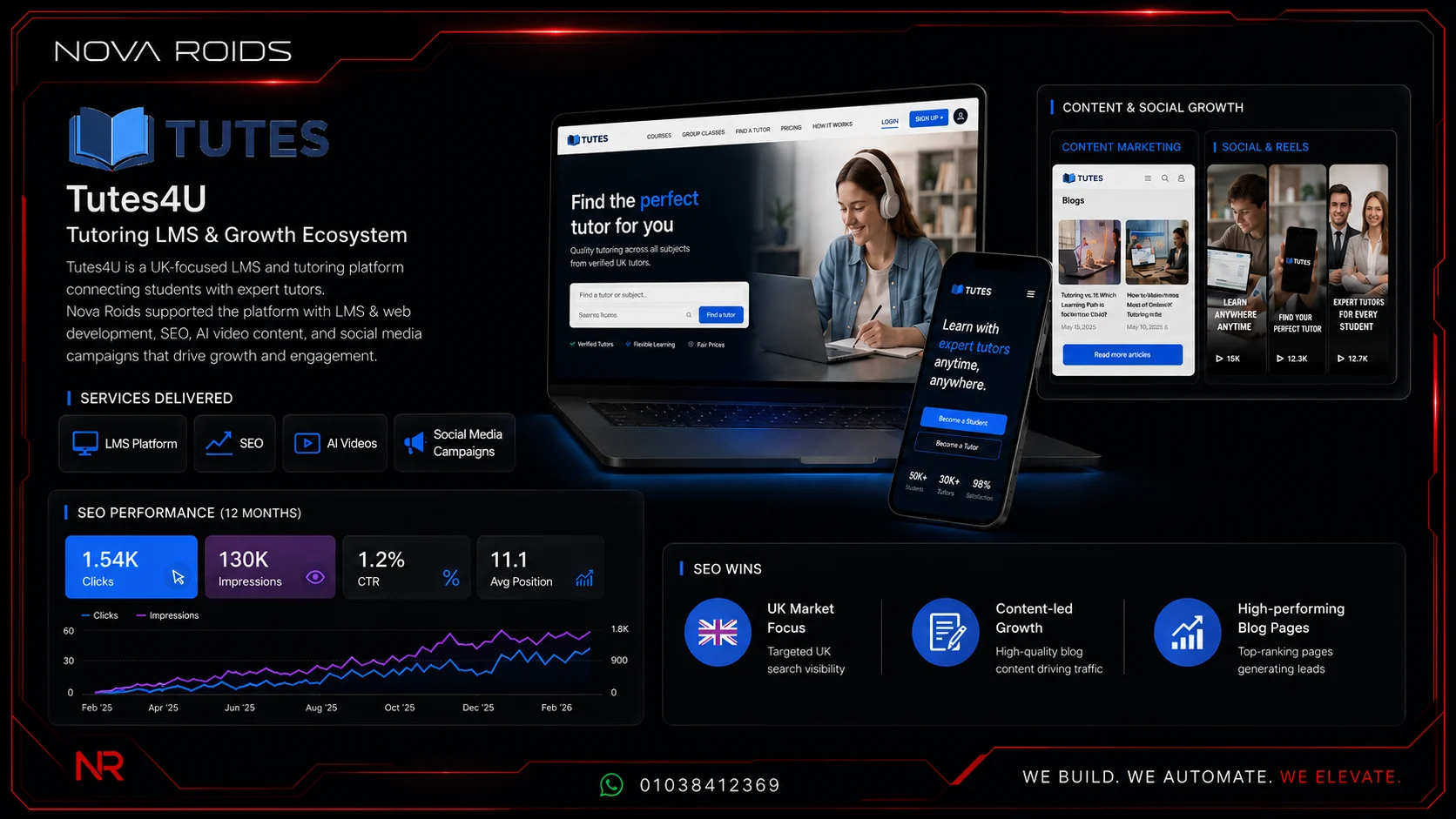
Tutes4U Learning Marketplace
A tutoring and learning marketplace connecting students, teachers, courses, group classes, bookings, and educational content.
Frequently asked questions
What is a content marketing strategy?+
It is a plan for researching, creating, distributing, linking, and measuring content that helps a defined audience make decisions and supports business goals.
How does content cannibalization happen?+
Cannibalization occurs when multiple pages compete for the same intent without a clear primary owner. Similar wording alone is not enough; the problem is overlapping purpose and unclear signals.
How often should content be published?+
Publish at the pace your team can research, edit, distribute, and maintain. A smaller number of strong, connected pages is usually better than frequent thin posts.
How should I use this content marketing strategy Egypt guide?+
Use the guide to define the decision, then follow the focused supporting articles for implementation details. The pillar gives the broad framework, while each cluster owns one narrower question so the site avoids repeating the same search intent across multiple pages.
When should this plan be reviewed?+
Review the plan whenever the offer, audience, platform, operations, or evidence changes. Update publication details only after a meaningful review, and recheck internal links so related pages continue to support rather than compete with one another.
What is the safest next step for content marketing strategy Egypt?+
Start with a written scope and a review of the current situation. Confirm the desired outcome, dependencies, evidence, ownership, and risks before selecting a platform or provider. This produces a more reliable plan than beginning with a tool or price alone.
Author and technical review
Primary references
Need a scoped recommendation instead of a generic answer?
Share the current system, target users, required outcomes, and deadline. The Nova Roids team will identify the smallest practical next step and the assumptions that need validation.