Key takeaways
- The store must fit local payment, delivery, and customer-service behavior.
- Catalog and category architecture should be planned before products are imported.
- Operations, analytics, and SEO are part of the product—not post-launch extras.
How this guide was prepared
This guide is written for organisations evaluating ecommerce website development in Egypt in Egypt. It separates this intent from direct service-page terms and avoids unsupported prices, rankings, guarantees, or client claims.
The article combines Nova Roids delivery experience, the project portfolio linked on this page, and the named primary technical references. Any volatile commercial detail should be confirmed during discovery.
What this page owns—and what it deliberately excludes
This is the canonical page for the ecommerce website development in Egypt query family. It answers the specific decision below without duplicating the service page or adjacent cluster articles.
Topics intentionally handled elsewhere
- Paymob implementation details
- Cash-on-delivery operations details
- General web development pricing
Direct service and enquiry intent belongs to our E-commerce Development service page.
Start with the commercial and operational model
An online store is not only a product grid. It connects acquisition, merchandising, inventory, checkout, payment, fulfillment, returns, customer support, and reporting. Document how an order moves from the first visit to delivery before selecting a platform.
Egyptian stores often need a combination of online payments, cash on delivery, WhatsApp support, location-aware shipping, and clear confirmation steps. These requirements should shape checkout and operations from day one.
Ready to move from planning to delivery? Review our e-commerce development process and deliverables.
Choose the platform around constraints
Hosted platforms can launch quickly and simplify infrastructure. WooCommerce offers editorial flexibility but requires disciplined maintenance. A custom commerce stack is justified when workflows, integrations, catalog scale, or user experiences cannot be handled cleanly by standard tools.
- Catalog size and product variants
- Inventory and accounting integrations
- Payment and shipping providers
- Content and multilingual needs
- Promotion and loyalty logic
- Internal team skills and support budget
Design category pages for search and conversion
Categories should reflect how customers search, compare, and navigate. Use unique titles, useful descriptions, indexable filtered pages only when they have real demand, and structured product data. Avoid generating thousands of thin parameter URLs.
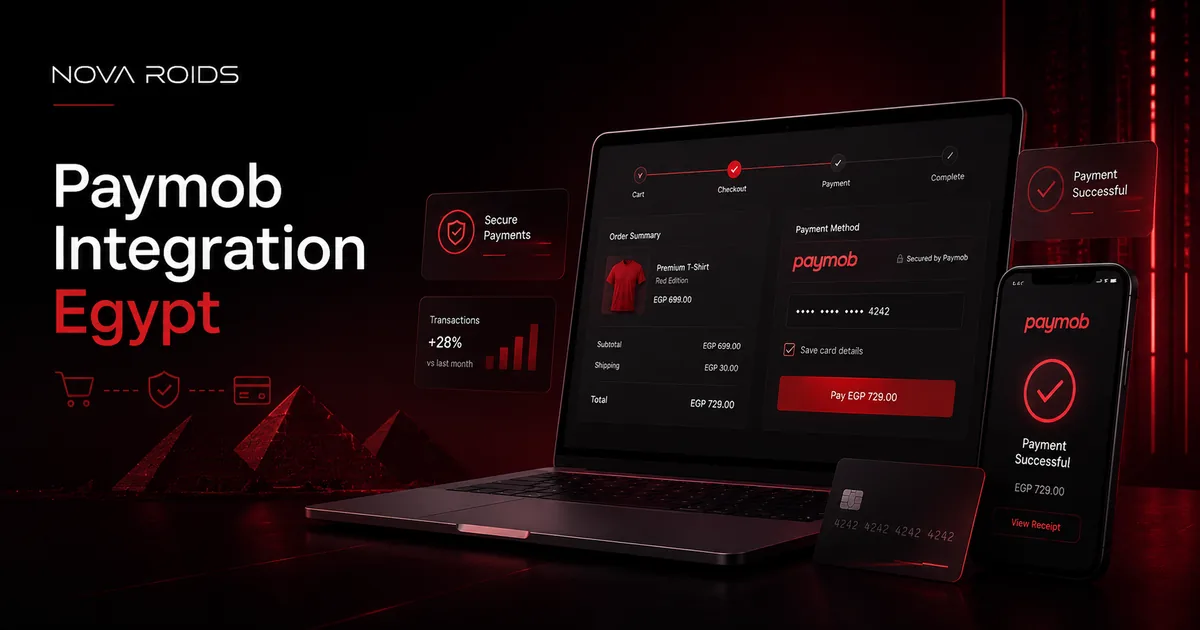
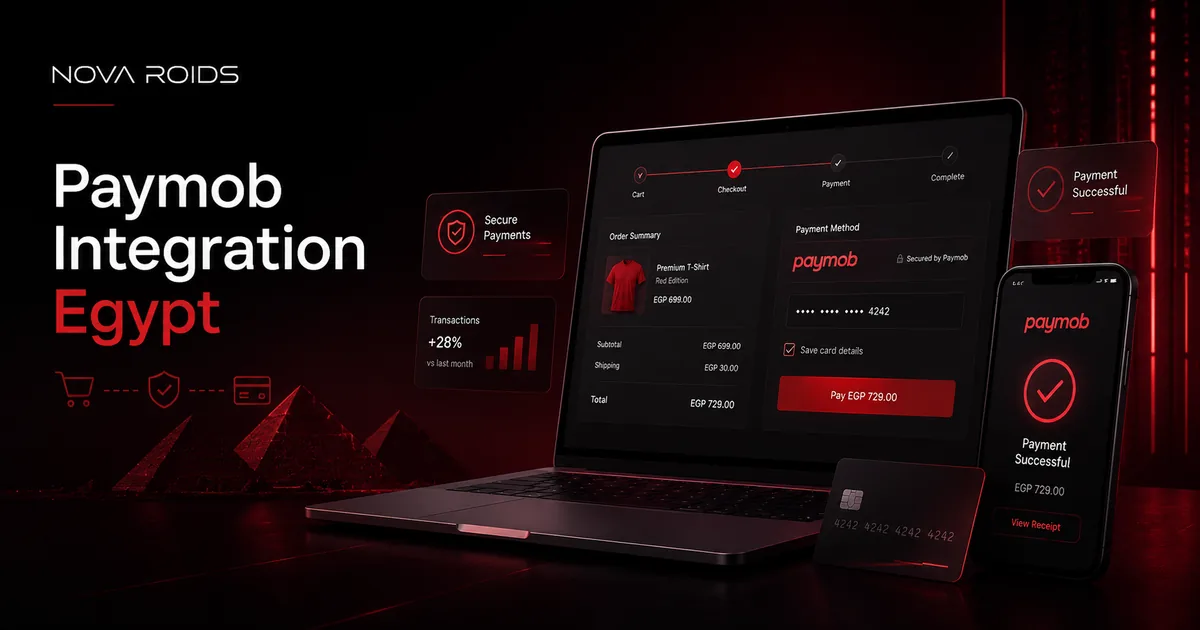
The next related decision is covered in Paymob Integration in Egypt: Checkout and Operations Checklist.
Measure the complete checkout journey
Track product views, search, add-to-cart, checkout steps, payment outcomes, and order confirmation. Segment by device, channel, region, and payment method. This reveals whether the problem is acquisition, merchandising, trust, payment, or delivery expectations.
- Optimize images without hiding product detail
- Show delivery and return information early
- Validate phone numbers and addresses
- Design resilient payment callbacks
- Keep order status visible to customers and staff
E-commerce requirements that must be decided before platform selection
Platform choice should follow the operating model. Document product types, variants, stock ownership, fulfilment locations, delivery zones, return rules, payment methods, promotions, customer accounts, tax handling, and reporting needs. A store that sells a small fixed catalogue has different requirements from a marketplace, subscription business, wholesale portal, or retailer synchronising inventory across branches.
The team should also decide who manages products, prices, images, orders, refunds, and support after launch. Ecommerce website development in Egypt succeeds when the admin experience reflects real staff responsibilities. A polished storefront cannot compensate for confusing order states or a back office that requires manual workarounds every day.
- Catalogue and variant model
- Inventory source of truth
- Payment and delivery rules
- Returns and refund workflow
- Roles and admin permissions
- Accounting, CRM, and fulfilment integrations
Checkout architecture for Egyptian customers
Checkout should make payment and delivery expectations clear before the final step. Show accepted payment methods, delivery areas, estimated timing language, fees, return conditions, and the information required to fulfil the order. Forms must work reliably on mobile devices and should validate phone numbers and addresses without creating unnecessary friction.
Cash on delivery and online payment need separate operational states. A placed order is not always a confirmed order, and a payment redirect is not proof of successful settlement. Design the system around verified callbacks, order confirmation, fulfilment, delivery outcome, cancellation, refund, and reconciliation so the customer and operations team see the same status.
- Mobile-first address capture
- Clear payment and delivery options
- Verified payment callbacks
- Order confirmation workflow
- Refund and cancellation states
Catalogue SEO and product discoverability
Search visibility depends on crawlable category structures, unique product information, useful filters, stable canonical URLs, structured data, internal links, and strong media. Avoid generating thousands of indexable parameter combinations that repeat the same products. Important categories should have clear purpose, descriptive headings, supporting copy, and links from the main navigation or relevant guides.
Product pages should answer practical buying questions rather than repeat manufacturer text. Include dimensions, materials, compatibility, usage, delivery, care, availability wording, and return information when verified. Images need descriptive filenames and alt text, but the page should remain fast. Structured data must match visible information and current stock or price data.
- Stable category URLs
- Controlled filter indexation
- Unique product descriptions
- Product and breadcrumb schema
- Optimised images with dimensions
- Links between guides, categories, and products
Launch and operations checklist
Before launch, test the full order journey for every payment and delivery method. Include successful payment, failed payment, abandoned redirect, duplicate callback, out-of-stock product, invalid coupon, refund, cancellation, and delivery failure. Verify emails, messages, admin notifications, analytics events, and the data sent to fulfilment or accounting systems.
After launch, monitor conversion by device, payment method, source, and checkout step. Review failed payments, cancelled orders, support questions, search terms, and product-page exits. The first weeks should be treated as an operational learning period with a clear process for prioritising fixes. Ecommerce growth is usually constrained by a combination of merchandising, trust, logistics, and usability—not one design element.
- Test every payment state
- Test inventory and coupon edge cases
- Verify analytics and order notifications
- Monitor failed orders and customer support themes
- Maintain a release and rollback process
Scaling from a store to a commerce system
As order volume and catalogue complexity grow, the website becomes one part of a wider system. Inventory, purchasing, customer service, warehouse operations, accounting, marketing automation, and reporting may need shared data. Plan integration boundaries early so staff do not re-enter the same information in several tools or depend on spreadsheets that become unreliable.
Scale should be driven by operational pain and evidence. Introduce automation where it removes repeated work or reduces errors, but keep clear human review for refunds, fraud, exceptions, and customer complaints. A modular architecture lets the business improve one capability without rebuilding the entire storefront.
- Define system ownership
- Prioritise high-friction manual tasks
- Use reliable APIs and audit logs
- Document exception handling
- Measure operational as well as marketing outcomes
A phased e-commerce delivery roadmap
Phase one should prove the catalogue, checkout, payment, delivery, order-management, and customer-support flow with a controlled product set. Phase two can improve merchandising, content, automation, loyalty, or integrations after the team understands real order behaviour. This keeps the first launch operationally complete without forcing every future idea into the initial schedule.
Before each phase, define acceptance criteria using real products, addresses, payment methods, users, and exception cases. The store should be tested by the people who will manage orders and refunds, not only by designers and developers. Operational feedback often reveals issues that are invisible in a visual review.
- Core catalogue and checkout
- Payment and fulfilment validation
- Operational pilot
- Evidence-led growth features
Commerce metrics that guide useful improvements
Monitor product discovery, search usage, add-to-cart rate, checkout progression, payment outcome, confirmed orders, fulfilment, delivery, returns, and support contacts. Segment by device, acquisition source, payment method, delivery area, and new versus returning customer where the data is reliable.
Use the data to identify the constraint. Low product views may be an acquisition or navigation problem; strong carts with weak payment success may indicate checkout or payment issues; high order volume with delivery failure points to operations. Improvements should target the stage that limits completed, profitable orders.
- Product and category engagement
- Checkout and payment completion
- Confirmed and delivered orders
- Returns and support themes
- Revenue and margin context
E-commerce platform decision table
| Approach | Best for | Trade-off |
|---|---|---|
| Hosted commerce platform | Fast launch with standard catalogue and checkout needs | Recurring platform limits and app dependence |
| WooCommerce | Content-led stores needing flexible WordPress ownership | Plugin governance, performance, and maintenance |
| Custom commerce | Unusual workflows, integrations, roles, or operational rules | Higher discovery, engineering, QA, and support responsibility |
Questions and checks before you commit
What clients highlighted
“The checkout, product pages, and tracking plan felt practical from day one. It was built around real operations, not just design screens.”
“The website finally explains our services clearly, loads fast, and gives our team a cleaner way to receive qualified enquiries.”
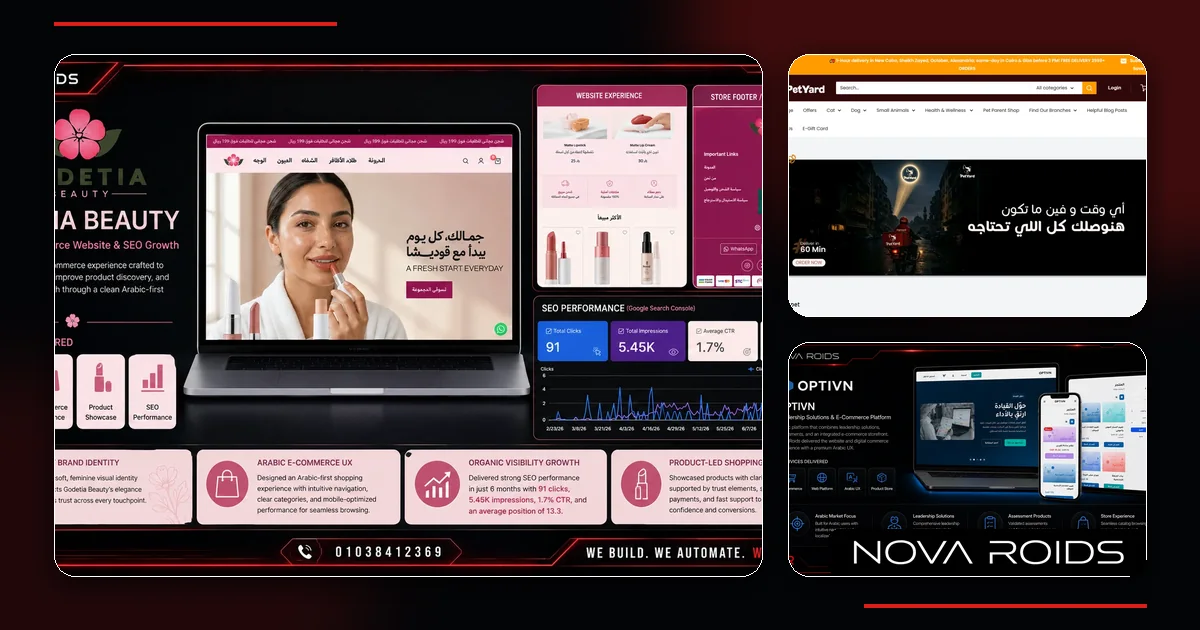
Relevant Nova Roids project work
These case studies show related delivery experience. They do not imply that every feature discussed in this guide was used on every project.

Godetia Beauty Commerce Growth
A Saudi beauty commerce ecosystem combining product discovery, editorial content, search growth, and conversion-focused journeys.

Petyard E-commerce Store
A pet retail experience with searchable catalog structure, product discovery, commerce operations, and organic visibility foundations.

Pure Touch Booking Ecosystem
A premium UAE booking platform for mobile car wash, home cleaning, pool care, locations, packages, and booking operations.
Frequently asked questions
What is the best e-commerce platform for Egypt?+
The best platform depends on catalog size, integrations, operating team, budget, and desired user experience. Shopify, WooCommerce, and custom systems can all work when matched to the right requirements.
Can an Egyptian store support Paymob and cash on delivery?+
Yes. Many stores support both, but payment callbacks, order status, reconciliation, fraud controls, and delivery confirmation must be designed carefully.
How long does an e-commerce website take to build?+
A focused store can launch faster than a custom marketplace. Timing depends on catalog readiness, design, integrations, migration, payment approvals, content, and testing.
How should I use this ecommerce website development in Egypt guide?+
Use the guide to define the decision, then follow the focused supporting articles for implementation details. The pillar gives the broad framework, while each cluster owns one narrower question so the site avoids repeating the same search intent across multiple pages.
When should this plan be reviewed?+
Review the plan whenever the offer, audience, platform, operations, or evidence changes. Update publication details only after a meaningful review, and recheck internal links so related pages continue to support rather than compete with one another.
What is the safest next step for ecommerce website development in Egypt?+
Start with a written scope and a review of the current situation. Confirm the desired outcome, dependencies, evidence, ownership, and risks before selecting a platform or provider. This produces a more reliable plan than beginning with a tool or price alone.
Author and technical review
Primary references
Need a scoped recommendation instead of a generic answer?
Share the current system, target users, required outcomes, and deadline. The Nova Roids team will identify the smallest practical next step and the assumptions that need validation.