Key takeaways
- Start with the user decision or task AI should improve before choosing a model.
- Voice, memory, multimodal input, and tool use each create specific UX, privacy, backend, and QA responsibilities.
- Use task-specific evaluations and product analytics to measure AI quality after prompt or model changes.
- AI products still need conventional mobile, backend, operations, website, SEO, analytics, and growth systems.
How this guide was prepared
This guide owns the AI mobile app development search intent and is designed to support the mobile app service page without duplicating direct company, pricing, or adjacent cluster intent.
The guidance combines Nova Roids product-delivery experience, the four mobile project case studies linked on the page, the supplied Google Search Console query patterns, and the named primary references. No market-wide prices, rankings, or guarantees are invented.
What this page owns—and what it deliberately excludes
This is the canonical page for the AI mobile app development query family. It answers the specific decision below without duplicating the service page or adjacent cluster articles.
Topics intentionally handled elsewhere
- General AI automation service intent
- Generic mobile app development company intent
- Unverified model benchmarks or AI performance claims
Direct service and enquiry intent belongs to our Mobile App Development service page.
The broader topic is covered by Mobile App Development Process: From Idea to App Store.
Start with the user decision AI should improve
AI mobile app development should begin with a user problem, not a model name. Decide what the user is trying to understand, create, predict, search, organise, or automate, and what a useful response looks like. A conversational interface is valuable when language is the natural input, but some tasks are better served by forms, structured recommendations, background classification, or a conventional workflow with AI assisting one step.
Define what happens when the AI is uncertain, unavailable, slow, or wrong. The product should not hide critical decisions behind a confident-looking response. For sensitive domains, add human review, citations, confirmation steps, or clear boundaries where appropriate. The AI experience and the operating workflow must be designed together.
Ready to move from planning to delivery? Review our mobile app development process and deliverables.
Choose cloud, on-device, or hybrid AI from privacy and capability needs
Cloud models can provide powerful language, vision, and audio capabilities without shipping large models inside the app, but requests depend on network access and may send user content to an external service. On-device models can improve privacy, latency, or offline behaviour for suitable tasks but are constrained by device resources, model availability, and platform support. A hybrid design can route different tasks to different execution layers.
The choice should be explicit in the architecture. Document which information leaves the device, which provider processes it, what context is stored, how long it is retained, and how failures are handled. Avoid promising that an AI app is private simply because the interface looks personal; privacy depends on the actual data flow and the controls around it.
This article belongs to the Mobile App Development Process: From Idea to App Store topic cluster.
Voice AI needs interruption, latency, and failure-state design
A natural voice experience is more than speech-to-text followed by a chatbot response. The product needs microphone permissions, recording states, interruption behaviour, transcription feedback, cancellation, network handling, playback, background changes, and a clear way to recover when recognition is wrong. Users should know when the assistant is listening, thinking, speaking, or stopped.
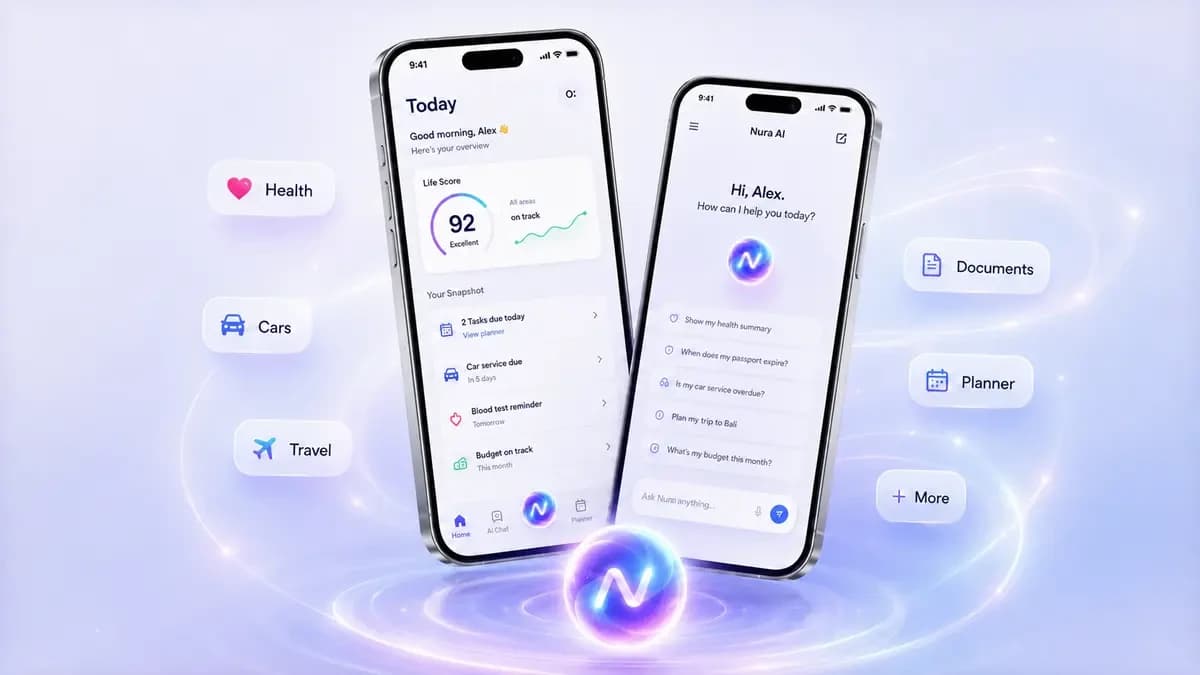
Nura AI provides a useful case-study pattern: the product includes Live Voice and voice-message paths within a wider personal assistant experience. The interface communicates a live listening state and allows natural interruption. The point is not to copy that design, but to recognise that voice needs a dedicated interaction model and operational telemetry rather than being treated as a single button added to chat.
The next related decision is covered in Mobile App Development Process: From Idea to App Store.
Memory and personal context need user control
Personalised assistants become more useful when they can retain relevant context, but persistent memory creates product and privacy responsibilities. Define which information can be remembered, what is temporary, what is linked to the account, how users inspect or remove stored context, and whether sensitive categories require additional limits. The interface should make memory behaviour understandable rather than invisible.
Nura exposes memory, permissions, privacy, connected services, notifications, and personalisation settings as product controls. That pattern illustrates a broader rule: if AI behaviour depends on stored user context, the user should have meaningful ways to understand and manage that context. Backend permissions and deletion workflows must support what the interface promises.
AI tool use turns a chatbot into an application
An assistant becomes operational when it can create tasks, query account data, schedule events, classify documents, update records, search a product catalog, or trigger other tools. Each action needs authorization, parameter validation, confirmation rules, idempotency, and auditability. The model should not be allowed to invent an action or operate outside the user's permissions simply because it can generate plausible tool arguments.
Separate language understanding from business rules. The model can help interpret intent, but the backend should enforce permissions, valid states, and allowed transitions. High-impact actions may require explicit confirmation. Logs should make it possible to determine what the user requested, which tool was called, what result returned, and what the interface ultimately displayed without storing more sensitive data than necessary.
Multimodal features require media and data pipelines
Photo, document, audio, and file analysis can create strong product value, but they introduce upload size, format, storage, antivirus or safety checks, processing time, retry, privacy, and retention questions. The app should communicate progress and allow a failed upload or analysis to be retried safely. Backend queues may be needed for work that cannot complete during one mobile request.
Nura's add flow groups documents, file uploads, photos, voice, expenses, events, reminders, tasks, and notes into one entry point. That type of interaction benefits from a common ingestion architecture behind the UI so each input becomes a structured object with clear ownership and lifecycle rather than a collection of unrelated one-off features.
Evaluate AI quality with task-specific tests
AI QA needs more than checking whether the model responds. Build evaluation sets from realistic user requests, difficult edge cases, ambiguous prompts, unsafe or disallowed instructions where relevant, and expected tool behaviour. Track answer usefulness, refusal quality, latency, tool success, hallucination risk, and recovery from missing data. Keep those tests when prompts or models change so quality does not drift silently.
Human review remains important for subjective and high-impact tasks. Product analytics can show where users retry, abandon, correct the assistant, or switch to manual workflows. Combine that behavioural evidence with structured evaluations before changing models or prompts. A newer model is not automatically a product improvement if it increases cost or latency without improving the tasks users care about.
AI cost is driven by product behaviour, not only model price
Budget planning should include model or inference usage, speech services, media processing, vector or search infrastructure, backend compute, logging, storage, moderation or safety tools, analytics, and support. Cost per request varies with context size, media, output length, model choice, caching, and the number of tool calls. The app should be designed so high-cost operations are intentional and observable.
Use real usage data after launch to optimize. Cache stable results where appropriate, shorten unnecessary context, route simple tasks to cheaper models, move suitable work on-device, and prevent repeated tool calls. Cost controls should not quietly degrade the user experience; changes should be measured against completion and retention outcomes.
The AI app still needs the normal mobile product ecosystem
AI does not replace conventional product engineering. The app still needs accounts, permissions, backend services, notifications, analytics, crash reporting, support, store releases, and often an admin or CRM layer. It also needs a website that explains the product clearly, support and policy pages, search content, and acquisition paths. Marketing should be able to measure whether people who respond to an AI message actually become activated users.
Nura AI and MUNCH AI are relevant Nova Roids project examples because they combine AI product experiences with the surrounding digital system. Their case studies support experience in consumer AI delivery, but each new app should still be scoped from its own users, data, risk, and operating model rather than assuming the same AI architecture applies everywhere.
AI mobile architecture decisions
| Capability | Product question | Engineering concern |
|---|---|---|
| Voice | Is conversation faster than typing for the task? | Permissions, streaming, interruption, latency, transcription |
| Memory | What context should persist and who controls it? | Storage, permissions, deletion, privacy, relevance |
| Tool use | What real action can the assistant perform? | Authorization, validation, confirmation, audit logs |
| Multimodal | Which files or media create useful context? | Upload, processing, retention, queues, cost |
Questions and checks before you commit
What clients highlighted
“The website finally explains our services clearly, loads fast, and gives our team a cleaner way to receive qualified enquiries.”
“The SEO structure made the site easier to understand. We could see which pages target traffic, which pages convert, and what to publish next.”
Relevant Nova Roids project work
These case studies show related delivery experience. They do not imply that every feature discussed in this guide was used on every project.
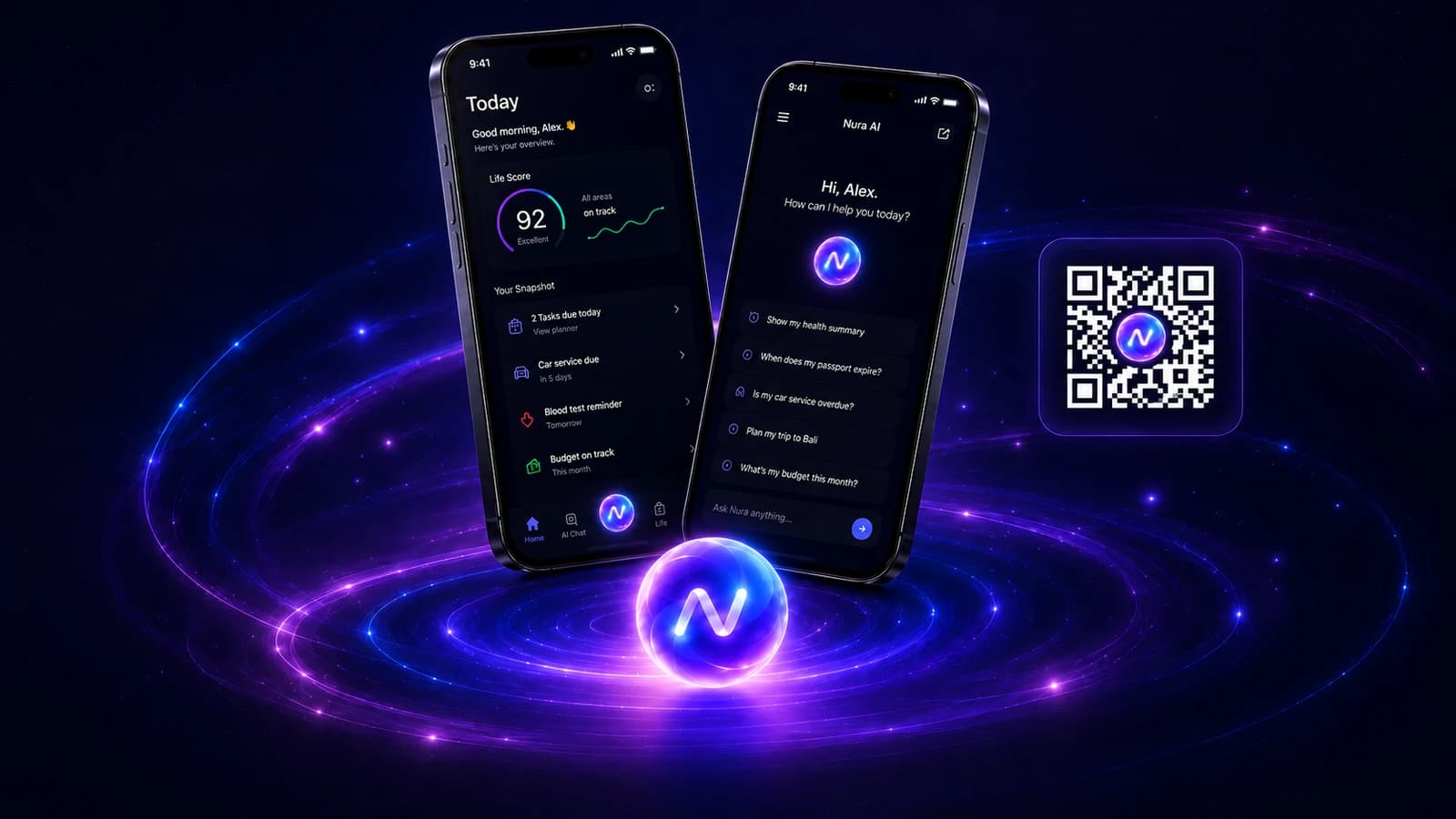
Nura AI Life Assistant
A personal AI life assistant for natural chat and voice, tasks, reminders, files, expenses, memory controls, and connected everyday context.
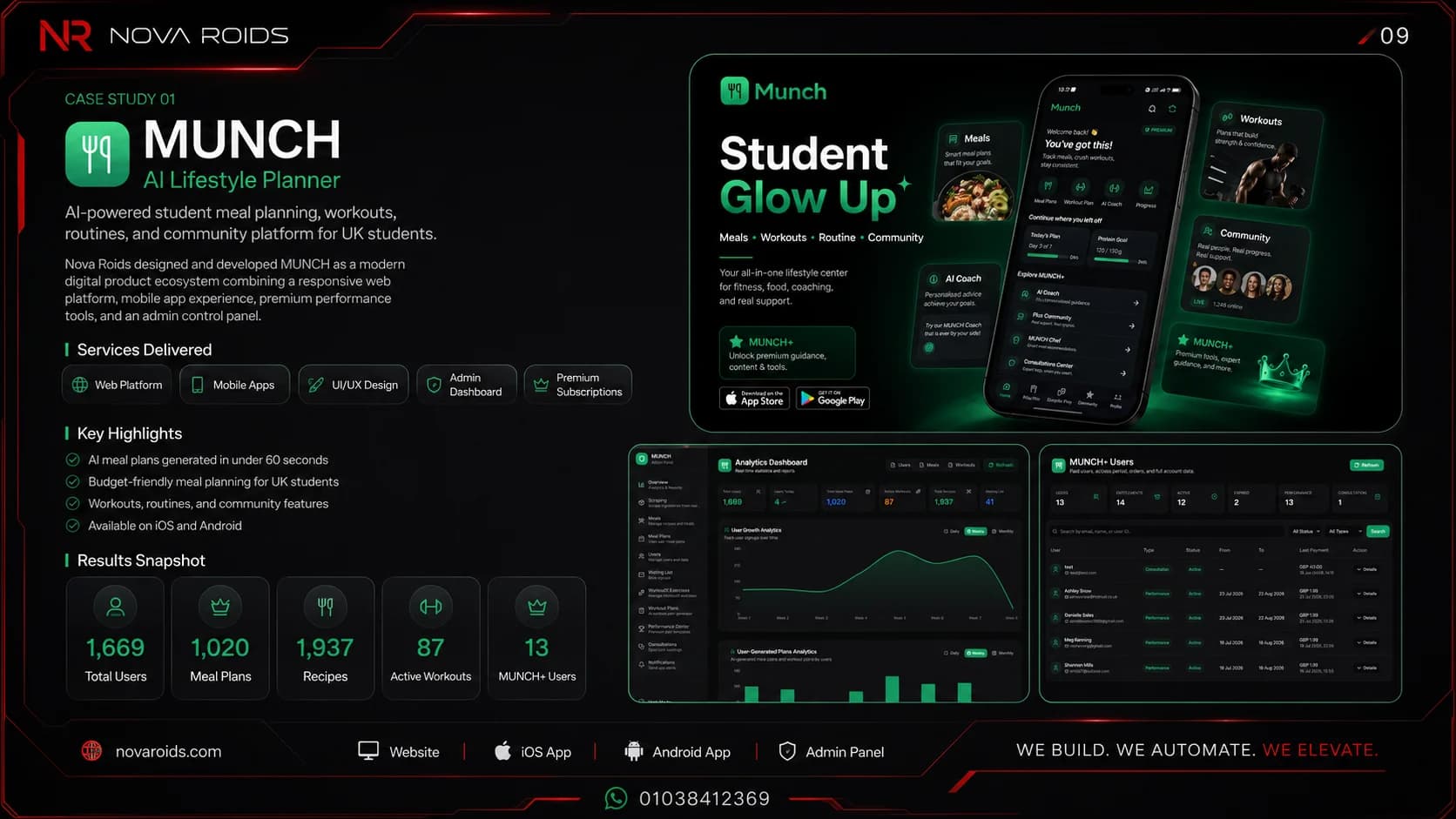
MUNCH AI Lifestyle Platform
An AI-powered mobile and web ecosystem for meal planning, workouts, performance tracking, community, and student lifestyle management.
Frequently asked questions
What is AI mobile app development?+
AI mobile app development combines a mobile product with machine-learning or generative-AI capabilities such as conversation, voice, recommendations, document understanding, image analysis, predictions, or workflow automation. The product still requires conventional UX, backend, permissions, testing, analytics, store release, and operational support.
Should an AI app use cloud or on-device models?+
The right choice depends on capability, privacy, latency, offline needs, device resources, cost, and platform support. Some products use cloud models, some use on-device inference, and others use a hybrid design that routes tasks to the appropriate layer. The data flow should be explicit and understandable.
How do you test an AI assistant app?+
Test realistic tasks, ambiguous requests, failure conditions, tool calls, unsafe requests where relevant, latency, and recovery. Maintain evaluation sets so prompt or model updates can be compared. Combine structured tests with product analytics and human review instead of judging quality from a few successful demos.
Has Nova Roids launched AI mobile products?+
Nova Roids project pages include Nura AI and MUNCH AI. Nura demonstrates live voice, memory controls, multimodal inputs, and life-organization flows; MUNCH demonstrates an AI-led lifestyle product ecosystem. The case studies show relevant delivery experience without implying that one architecture fits every AI app.
Author and technical review
Primary references
Planning a mobile product?
Share the users, core workflow, required integrations, target market, and first-release goal. Nova Roids will help turn the idea into a scoped product system.